(June 15, 2019 / Photo: Jorge Ibanez)
Back when we had our bakery, my go-to source for bread ideas was Bernard Clayton’s bread bible <em>The Complete Book of Breads</em>, a monumental work of culinary research. Of course, those were home recipes and it took some calculations to translate them to a commercial yield size and, sometimes, actually a couple of failed tries. But it was an endless source of new routes to explore.
When we first arrived in Gainesville, I came equipped with a copy of the complete recipe files from my first internship at baking commercially, Our Daily Bread, in Santa Barbara, courtesy of my mentor, Zeev (I never got his last name!). To find immediately that not everything plays in Peoria. The Florida climate was not friends to California recipes. Should we fight it? Tried a couple more times. Still not good? Time to move on.
So, it was to the <em>Tassajara Bread Book</em> to carry the day. We were hell bent on being an artisanal bakery, specializing in fine variations of whole wheat breads. With a couple of nips and tucks to the main whole wheat recipe to accommodate local tastes (c’mon, let’s be real, this was not southern California, it was 1982 Gainesville = Mother Earth, Down to Earth, and downtown Horse Feathers country bar) it was the buddhist monks and not Zeev’s whole wheat bread that would represent us. And it became very popular and even got wide area distribution by the Orange Blossom Cooperative (now defunct, gone with the Gainesville hippies). But, sorry Charlie, again, this was Gainesville. The two small independent bakeries were Beehive Bakery and Rex’s Bakery. Hoagie Dough anyone? So, all the infinite Edward Brown’s variations of the Tassajara Bread (Corn-Millet bread, Rye-Oatmeal ,etc) was not going to be enough. Time to diversify. And I run into Bernard Clayton’s amazing book.
A variation of his recipe for Shepherder’s bread was one of my favorites to bake and one of our customer’s favorites to savor. It is included in his sour dough breads section in his book. And according to his introduction, it is traditionally baked in Dutch ovens by Basque shepherds in the Idaho mountain ranges. He adapted it to bake at home, among other things adding yeast to the main dough.
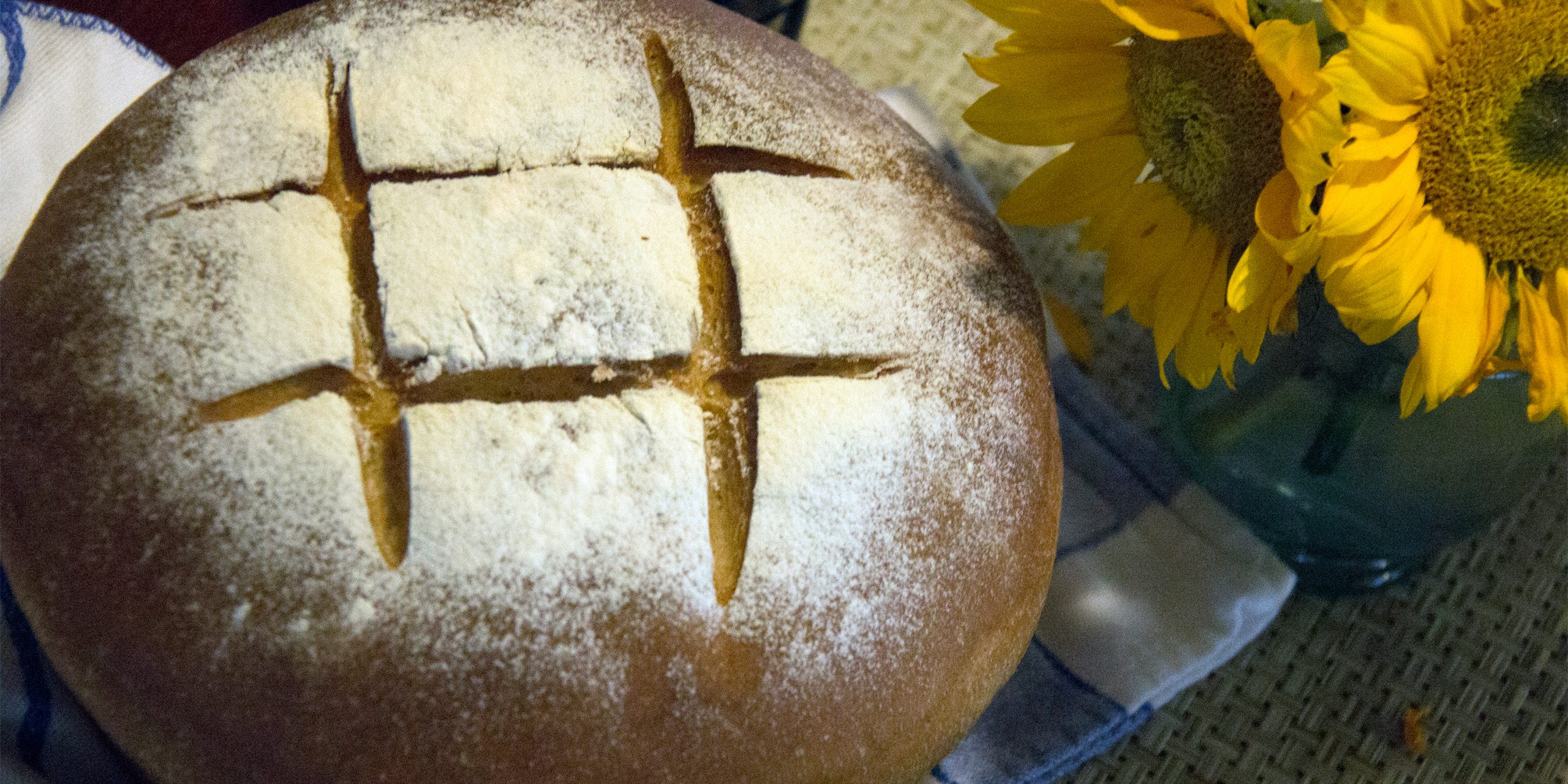
Besides of course adapting the recipe for commercial yield, I also adjusted some of the ingredients proportions and added whole wheat flour (half and half). We baked it in 1 ½ lb. imposing round loaves with Clayton’s suggested tic tac toe pattern slashes on top. And this and our ‘pan de agua’ (Puerto Rican answer to French bread) were to me the most delicious breads we ever made, one of Clayton’s most important contribution to our bakery’s recipe file and an absolute confirmation that, by golly, all bread should be made with a sour dough base! Hands down…
I tell you, I swear by this book. I mean, not really, but you know what I mean.
I have included my version of the recipe. I think, and I think everyone that tastes it would agree, that besides the sour dough starter, the addition of whole wheat adds lots to the taste. It makes amazing egg and cheese sandwiches or an out-of-this-world buttered toast. Normally we used to bake it free form in round loaves on bakery full pans. This time I baked it in a pyrex glass bowl and it made for a real cool shape.
Let me know how it works for you.
Sheepherder’s Bread
Ingredients
- 1.5 cups of Starter (see recipe below)
- 2.5 cups all-purpose flour
- 2.5 cups whole wheat flour
- 3 tablespoon sugar
- 1 tsp. salt
- 1 package (or 21/4 tsp) yeast
- 1 cup non-fat dry milk (optional, but makes big difference)
- 1 cup warm water
- 2 Tbsp butter, room temp
- Bread Pan (suggested for a bodacious looking loaf)
- a 4.0 Qt. Pyrex oven safe mixing pan
Preparation
- In a small bowl, mix the water and the dry yeast. Allow it to ‘proof’.
- In a large mixing bowl, mix together 1 cup flour, sugar, salt, dry milk and yeast slur.
- Add the butter and the starter and beat to make thick batter (if using a mixer with dough hook, beat at medium speed for two minutes).
- Add two cups of flour (half and half), half a cup at a time (two minutes at high speed in a mixer).
- Add the additional flour, half a cup at a time, to make a soft elastic dough. It will be kind of sticky, shaggy and rough
- Knead until the dough is no longer sticky, adding a little more flour if necesssary. By now you should have an elastic and smooth dough.
- Return to bowl, pat with greased or buttered hands, and put it away in a warm place until it doubles in size about 45 minutes to an hour. My favorite trick is to put in the oven and put a medium bowl of hot water under it to create steam inside the oven.
- Turn dough on your work bench and knead for about one minute to press out the bubbles.
- Form into a ball, place in well floured baking sheet or well greased glass bowl and put it back to raise, probably about an hour.
- Now comes fun. Preheat the oven to 400 degrees. Brush the loaf with water. Sprinkle white flour (for better contrast, white flour works better here…) on top of raised loaf and cut tic tac toe or cross slashes on top. These slashes will help the loaf raise even more in the oven.
- Like Bernard likes to say: “Bake until done”. But seriously, about an hour, but check about 45 minutes into it. The loaf should be golden brown and sound hollow if tapped on the bottom. One advantage of using the Pyrex bowl method is that you can see if it looks cooked on the bottom.
Sour Dough Starter
Mix all ingredients in a no-metallic bowl. Leave in a warm place to ferment 4 to 8 days, depending on your kitchen’s temp and humidity. Once it develops a pleasant sour smell, you can put it in a jar and place in the refrigerator to keep. If it has developed any kind of colored hue on top, throw it out and start again. Color on a starter sponge is a very bad sign. When you are ready to use it, pull it out of the refrigerator and allow to come to room temperature. I normally take it out of the refrigerator the night before.
Ingredients:
One package active dry yeast
Two cups warm water
Two cups all-purpose flour